
THE REAL DEAL 2



Manuel Farello’s restaurant management firm is making a real estate change –– a pivot that’s expected to pay o; with a $200,000 tax writeo;.
After years of leasing workspaces across Miami-Dade County, Farello’s Miami-based Silver Spoon Solutions, which provides accounting and other back-o;ice services for food and beverage venues, will purchase an o;ice. The move allows it to tap federal tax savings under a Trump administration law passed last summer.
Under the One Big Beautiful Bill Act’s 100 percent bonus depreciation, buying a company ofice unlocks two types of deductions.
One is for the value of elements of the building that wear out over time — anything from carpets and blinds to HVACs and some electrical and plumbing systems. The second covers everything needed to make the space operational, including computer servers and other technology, furniture and fixtures.
The benefit doesn’t apply to the building structure itself, which has its own deduction schedule, with those writeo;s spread out over nearly four decades.
Silver Spoon is poised for healthy profits this year and next, money that Farello would rather put to work than hand over to the IRS. “Instead of paying more taxes, why don’t I invest in something I know I need [for my business] and I can take the full depreciation,” he said. That way, “you own the property, plus you get the bonus depreciation.”
The tax rule is meant to spur economic growth by having companies invest in themselves, and it’s not just for o;ices. Restaurants, retailers and other operators that own commercial spaces for their businesses can take the deductions.
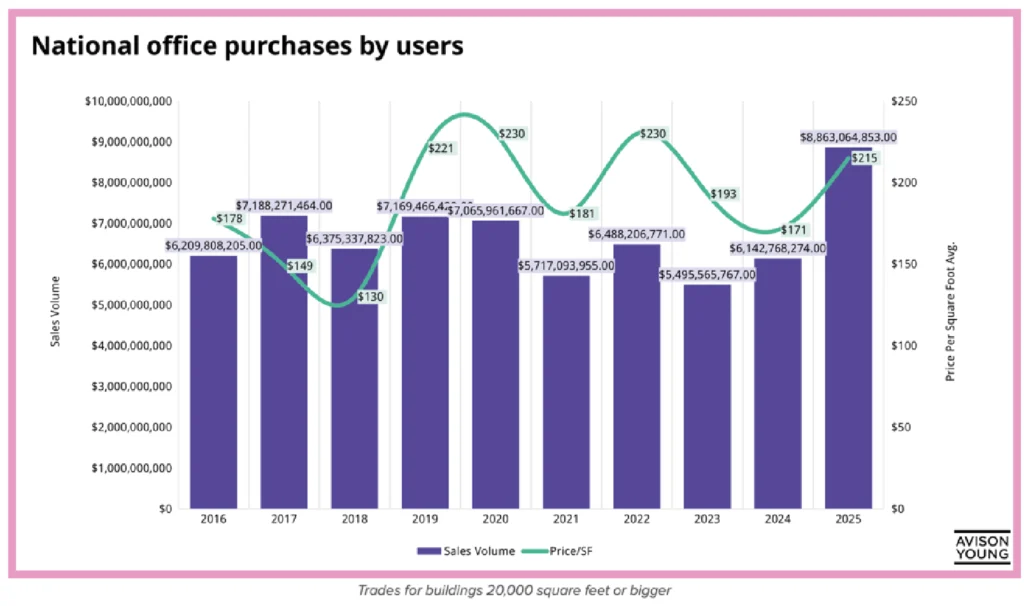
But the law came at an opportune time for companies that purchase or own their ofice space, amid a surge nationwide of user-owned o;ices, both developed and purchased.
After hybrid work reshaped ofice demand, many firms now know exactly how much space they need and what they want and are opting to create it themselves on their own terms as their own landlord. The behemoths building their workspaces include Ken Gri;in’s Citadel and Spanish bank Banco Santander, which plan towers in Miami’s Brickell, while AT&T is plotting a Plano, Texas, campus. User purchases peaked at $8.9 billion last year, or 15.6 percent of o;ice deal volume, the highest volume for at least the past decade, according to Avison Young.
Bonus depreciation isn’t a driving force. It’s one of several forces nudging firms toward ownership, and it’s juicing the numbers for owner-user o;ices amid the widespread market shift, experts said.
“Companies appreciate it, and they are, of course, going to utilize it,” said Steve Triolet, a commercial real estate expert in Dallas. “It’s icing on the cake.”
Workings of a tax law Laws allowing workarounds to paying taxes on real estate are not novel, with Trump
himself using them in the past for some of his investment properties.
Bonus depreciation specifically also has been on the books for some time, but the “beautiful bill” act supercharged it. Owner-users use cost segregation studies to isolate the building portions eligible for deductions and determine their value. Generally, these portions are valued at roughly 30
percent of an o;ice’s value, experts said.
Historically, owner-users could write o; 50 percent of the value in the first year they opened their spaces but for the balance of the value, they had to spread write o;s over subsequent years. The old way had other limits, applying only to brand-new qualifying building elements, which rendered it less useful for ofice spaces.
The Tax Cuts and Jobs Act of 2017, another Trump law passed during his first term, implemented 100 percent bonus depreciation –– enabling owner-users to claim a full deduction in the same year they opened their locations –– but that, too, had constraints. It mandated a step down of the deductions. Starting in 2023, only 80 percent could be deducted in year one, with the balance of the writeo; spread over time. The phasedown continued — 60 percent in 2024, 40 percent in 2025 — and was set to expire altogether by 2027.
Here’s how it all plays out: If an owner-user bought its o;ice for $1 million, it would claim a roughly $300,000 tax deduction in the year it opens its o;ice. If the owner-user sells its property for $1.1 million a decade later, it’s on the hook for capital gain taxes on the $100,000 capital gain and, separately, for taxes for the $300,000 originally deducted.
In this case, a firm “got a reduction up front and got to enjoy that amount of money for 10 years and then it has to pay taxes on it,” Yevoli said. “It’s a win” for that firm.
Sweetener
Across the U.S., a confluence of factors have aligned to push firms to become o;ice ownerusers. Buyers are largely drawn to cratering values in o;ice buildings from their peak around 2021.
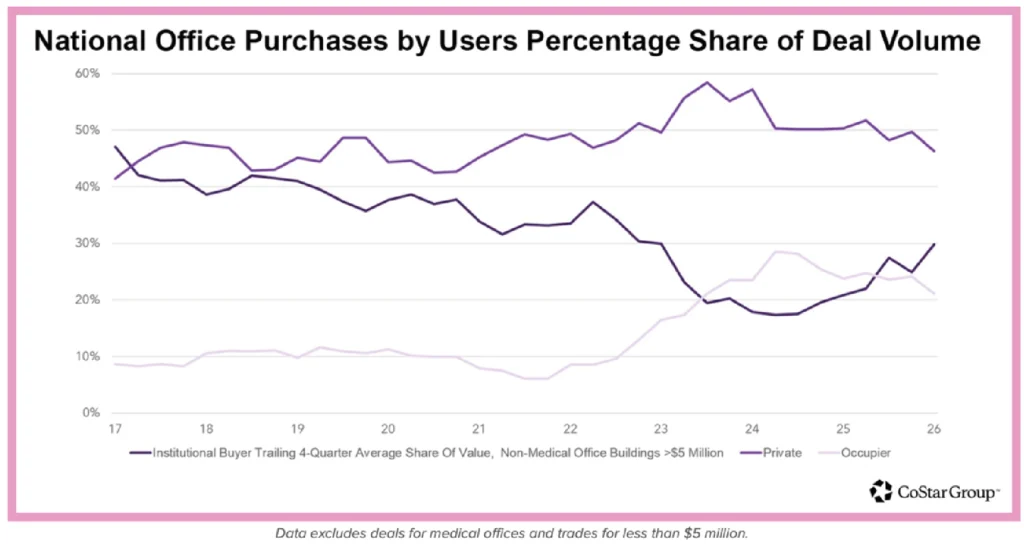
Amid pandemic-era questions about o;ice viability due to hybrid work and decreasing occupancies, historically low interest rates kept institutional investors in the game, said Phil Mobley, national director of o;ice analytics at CoStar Group. CoStar bought its Arlington, Virginia, headquarters, in 2024 for $339 million, including $14.2 million for the land and the balance for the building.
Once rates rose, institutional buyers stepped back, and owner-users seized their chance. Much of the owner-user activity is concentrated in submarkets where values have dipped most: more so in downtown Los Angeles, not premier Century City; Chicago’s Loop but not the trendy Fulton Market; in Texas, that’s Houston instead of Dallas; and in South Florida, it’s areas such as Fort Lauderdale and Wilton Manors, which didn’t benefit as much as Miami’s Brickell and downtown West Palm Beach from the influx of out-of-state firms in the past half-decade.
Lenders tend to be keener on backing owner-user purchases, since the deals solve the occupancy question. Still, that’s on a case-by-case basis, as owner-users don’t always move as fast as lenders would want, and they prefer to take their time to ensure they select the right o;ice, experts said. Owner-users also can tap Small Business Administration loans for their o;ice purchases, as well as local economic development incentives.
Bonus depreciation often is a secondary consideration for owner-users, especially in areas where values have significantly dipped and once-marquee buildings are available for a fraction of replacement cost.
But it’s “more of a cherry on top,” said David Kimball of Transwestern in Chicago, not the driving force.
Owner-users’ calculus before closing is complex. While their lease payments also benefit from tax deductions, so does the interest on their acquisition loan. Then again, if they buy and use the bonus depreciation, they run the risk of state taxes increasing and eating up what they saved through the federal tax deferral tool. Or, the federal tax rate could increase, so they pay more when they sell their property.
“What’s their current tax exposure? What’s their projected tax? What’s their current tax rate? What are they projecting future tax rates? … There’s not one right answer. It’s complicated,” said David Shapiro, tax attorney at Saul Ewing in Philadelphia.
Where the tax rule has played an outsized role is o;ice condo buildings. Users buy only their own suites instead of an entire building, saving them from the trouble of having to also become landlords for the space the owner-user isn’t occupying.
At Square Hallandale –– an eight-story project where Silver Spoon, the restaurant management firm, is buying its space –– buyers reserved 60 percent of o;ice condo suites within three months of sales launching, said Arie Abadi of project developer Four West Developers.
“That tax benefit was a huge selling point for us, and people are understanding its benefits,” Abadi said, adding that buyers include accountants, architects and health care providers. “They … have expressed interest in buying because of the tax benefit.” Farello, of Silver Spoon, said the firm plans to pay roughly $900,000 for its Square Hallandale suites. The projected $200,000 deduction under bonus depreciation breaks down to $150,000 for building elements with a finite lifespan and at least another $50,000 for everything it needs to set up the space for sta;, he said.
“I am going to take the opportunity to buy new equipment … computers, servers, things that I need in the o;ice, the furniture, the desks, the chairs, the fixtures on the walls,” Farello said. “We have the money, and it’s going to help us for tax liability.”
For Silver Spoon, the decision was 60 percent rooted in its ability to tap favorable SBA financing and 40 percent in the tax benefit, Farello said. But for other Square Hallandale buyers, such as health care providers that need a lot more equipment for their o;ices, this calculus may flip in favor of the tax benefit.
“They are going to kill with the bonus depreciation,” he said. “For them, it would be 60-40 [percent] the other way or even 70-30.”

